Abstract
A total solar eclipse presents a rare geometric coincidence in which the lunar limb acts as an opaque straight edge between the observer and a nearly point-like source of bright light — the solar chromosphere emerging at second and third contact.
This paper analyzes the resulting light distribution at the observer's plane using Fresnel knife-edge diffraction theory, derives the characteristic fringe scale of approximately fifteen metres for visible light at the Earth–Moon distance, and compares this well-understood wave-optical effect with the geometric-optics deflection of sunlight by the gravitational field of the Sun.
It then addresses a natural question: since the photons diffracting around the Moon have first grazed the Sun and been deflected by its gravity, can the wavefront arriving at the Moon be treated as planar? We show that the Sun's deflection imposes a curvature on the incoming wavefront that is, by many orders of magnitude, too small to displace the Fresnel fringe pattern within any currently achievable measurement precision — but we set out the formalism required to compute the correction and note its kinship with lunar-occultation techniques already used in radio astronomy.
Explainer
A short visual walk-through of the geometry: deflection at the solar limb, diffraction at the lunar limb, and why the two live on completely different length scales.
Notation
Symbols used throughout. Subscript ⊙ denotes solar values; ☽ denotes lunar values.
| Symbol | Meaning | Value used |
|---|---|---|
| \(\lambda\) | wavelength of light | 550 nm (visible) |
| \(L\) | distance, lunar limb to observer | \(3.844\times10^{8}\) m |
| \(r\) | distance, Sun to Moon | \(\approx\) 1 AU \(=1.496\times10^{11}\) m |
| \(b\) | impact parameter (closest approach to the Sun) | \(\approx R_\odot = 6.96\times10^{8}\) m |
| \(\alpha\) | gravitational deflection angle | 1.75″ at \(b=R_\odot\) |
| \(v\) | dimensionless Fresnel parameter | \(x\sqrt{2/\lambda L}\) |
| \(\ell_F\) | Fresnel length \(\sqrt{\lambda L}\) | \(\approx 14.5\) m at the observer |
| \(f_\odot\) | focal length of the solar gravitational lens | \(\approx 548\) AU |
| \(G\) | Newton's gravitational constant | \(6.674\times10^{-11}\) N m²/kg² |
| \(c\) | speed of light in vacuum | \(2.998\times10^{8}\) m/s |
| \(M_\odot\) | solar mass | \(1.989\times10^{30}\) kg |
| \(R_\odot\) | solar radius | \(6.96\times10^{8}\) m |
Introduction
Almost every textbook treatment of general relativity begins with the same photograph: a starfield taken during the total solar eclipse of 29 May 1919, on which Arthur Eddington and his collaborators measured the displacement of stars whose light had grazed the solar limb. The measured deflection — close to the 1.75 arcseconds predicted by Einstein, and almost exactly twice the Newtonian value — was the first empirical confirmation of general relativity and made Einstein a public figure within weeks. For more than a century, the solar eclipse has therefore been associated with one thing in the minds of physicists: the bending of starlight by gravity.
A solar eclipse, however, is simultaneously staging a second, entirely different optical experiment, and one that is almost never discussed in the same breath. At second contact, when the last thin crescent of photosphere disappears behind the advancing limb of the Moon, and again at third contact when it reappears, an observer stationed anywhere within the path of totality is positioned behind a natural opaque screen roughly 3,474 kilometres in diameter, illuminated on the far side by a bright, nearly point-like source. This is, in essence, the canonical geometry of Fresnel knife-edge diffraction — the same geometry that produces the Arago spot, the bright fringes at the edge of a razor's shadow, and the interference bands observable whenever a star is occulted by the Moon's limb.
Gravitational deflection is an arcsecond-level phenomenon on angular coordinates; diffraction is a metre-scale phenomenon on transverse spatial coordinates.
The question this paper asks is whether these two effects — gravitational deflection and knife-edge diffraction — should be regarded as entirely independent phenomena operating on the same sunlight at the same moment, or whether there is a meaningful correction in which the first modifies the second. Put concretely: the photons that diffract around the lunar limb have, moments earlier, grazed the Sun and had their trajectories deflected by solar gravity. Does this deflection alter the subsequent diffraction pattern in any way that could, in principle, be measured?
We will find that the answer is yes in principle and no in practice, but that the exercise of working through it carefully is instructive. It clarifies why the original intuition — that gravity and diffraction should somehow combine into a single, more powerful formula — is physically incorrect, and it places the Moon's edge during totality in the same family as the occultation geometries that radio astronomers have exploited since the 1960s to measure angular sizes far below the diffraction limit of their instruments.
The Geometry of the Eclipse
Consider an observer standing inside the umbra during a total solar eclipse. The Sun lies at a distance of approximately one astronomical unit. The Moon lies very much closer, at a mean distance of \(3.844\times10^{5}\) km. The Moon's diameter, 3,474 km, subtends at the observer almost precisely the same angular size as the Sun — this is the coincidence that makes total solar eclipses possible at all — so the geometry is nearly one of an opaque disc, of radius \(R\approx1{,}737\) km, exactly masking the solar photosphere.
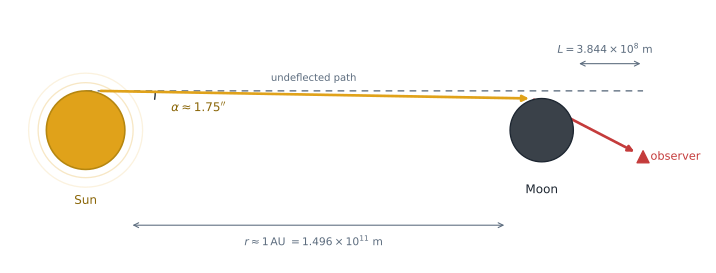
Near second and third contact, the relevant portion of the limb is locally well-approximated as a straight edge. The lunar radius is enormous compared with the Fresnel zone sizes we shall compute, so curvature corrections to the limb are negligible; what matters is only that an opaque half-plane lies between the observer and an illuminated region.
Which gravity — the Sun, not the Moon
It is worth pausing on a point that is easy to get backwards. The most natural reading of "an eclipse experiment" is that the Moon — the body sitting directly in front of the Sun — is the one bending the light. It is not. The Moon plays two roles in this work, and neither is gravitational: it is the opaque edge that creates the knife-edge diffraction (pure geometry — a cardboard disc of the same angular size would do it identically), while the gravity that curves the wavefront is the Sun's, acting upstream on the sunlight before it ever reaches the Moon's limb.
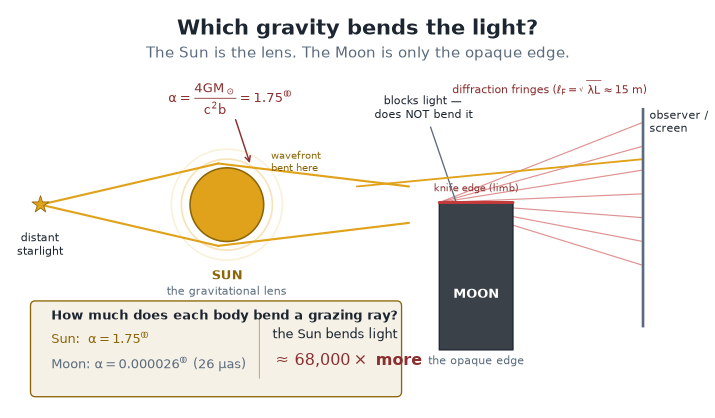
The reason it must be the Sun is a matter of mass. The deflection of a ray grazing each body at its own limb is \(\alpha=4GM/c^2R\): for the Sun this is the Eddington value \(1.75''\); for the Moon it is about \(2.6\times10^{-5}\) arcseconds — 26 micro-arcseconds. The Sun bends light roughly 68,000 times more strongly, because it is some 27 million times more massive. Projected across the entire Earth–Moon distance, the Moon's total gravitational deflection amounts to about 48 mm — against a fringe pattern whose features are fifteen metres across. The Moon earns its place in the experiment purely as the sharp opaque rim; every mention of "gravity" or "lensing" in what follows refers to the Sun.
Fresnel Diffraction at a Straight Edge
3.1 · The Fresnel–Kirchhoff integral
The light distribution produced by an opaque half-plane in front of a coherent point source is one of the oldest solved problems in physical optics, predating the discovery of the electron. Let an opaque screen lie in the plane \(z=0\), occupying the half-plane \(x<0\), and let an observation point \(P\) be situated at perpendicular distance \(L\) behind the screen at transverse coordinate \(x\). In the Fresnel (paraxial) approximation, the scalar field at \(P\) is
\[ U(x) = \frac{U_0}{\sqrt{2}}\left[\left(\tfrac12 + C(v)\right) + i\left(\tfrac12 + S(v)\right)\right], \]
where \(C(v)\) and \(S(v)\) are the Fresnel cosine and sine integrals,
\[ C(v)=\int_0^{v}\cos\!\left(\tfrac{\pi t^2}{2}\right)dt, \qquad S(v)=\int_0^{v}\sin\!\left(\tfrac{\pi t^2}{2}\right)dt, \]
and \(v\) is the dimensionless Fresnel parameter
\[ v = x\sqrt{2\left(\tfrac{1}{\lambda L}+\tfrac{1}{r}\right)}. \]
For the eclipse, \(r\gg L\), so \(1/r\) is negligible compared to \(1/L\) and the parameter reduces to the familiar form \(v\approx x\sqrt{2/\lambda L}\). The intensity at the observer is \(I(x)=|U(x)|^2\), normalized so that deep in the illuminated region (\(v\to+\infty\)) the intensity approaches the unobstructed value \(I_0\), and deep in the geometric shadow (\(v\to-\infty\)) it falls to zero.
3.2 · The fringe pattern
The intensity at the geometric shadow boundary itself (\(v=0\)) is exactly \(I_0/4\) — a quarter of the unobstructed brightness — rather than the half that naive geometric optics would suggest. In the illuminated region, \(I(x)\) oscillates, reaching a first maximum of roughly \(1.37\,I_0\) at \(v\approx1.22\), before the oscillations damp toward the unobstructed value. In the shadow region, \(I(x)\) decreases monotonically and smoothly into darkness.
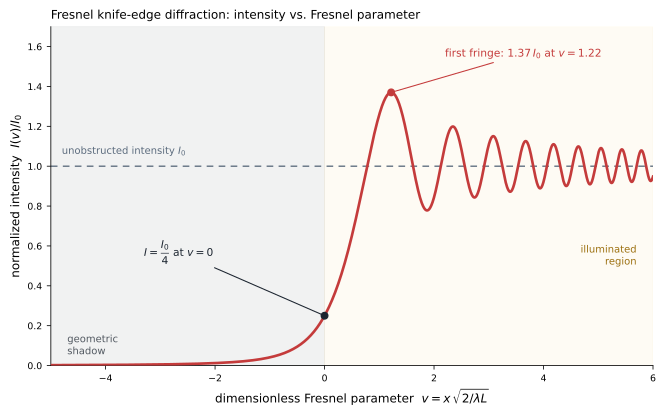
scipy.special.fresnel.The physical scale of these fringes is set entirely by the Fresnel length \(\ell_F=\sqrt{\lambda L}\). Substituting \(\lambda=550\) nm and \(L=3.844\times10^{8}\) m,
\[ \ell_F=\sqrt{5.50\times10^{-7}\,\text{m}\times3.844\times10^{8}\,\text{m}}\approx14.5\ \text{m}. \]
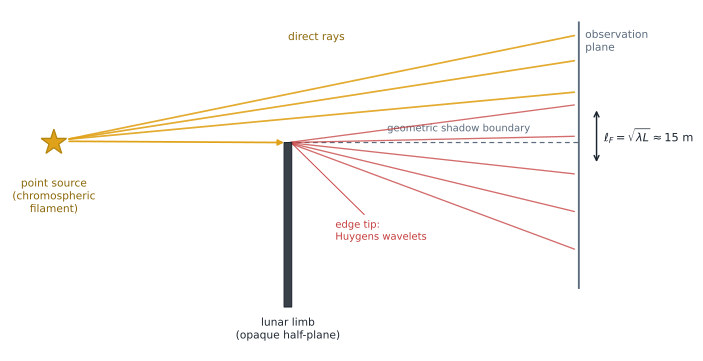
This is the width, in metres, over which the dominant transition from light to shadow occurs on the ground beneath an eclipse, for a genuinely coherent point source. Individual fringes within this envelope are spaced more finely, with the first bright maximum occurring at
\[ x_1 \approx 1.22\sqrt{\lambda L/2}\approx12.7\ \text{m}, \]
and subsequent fringes closer together. That the predicted spacing is measured in metres rather than millimetres is a direct consequence of the enormous distance \(L\) from the diffracting edge.
3.3 · Why the observed shadow edge is not so sharp
A reader who has stood in the path of totality may object that the actual edge of the umbra is in no way sharply fringed: the transition from daylight to darkness occurs over tens of kilometres of landscape, not over fifteen metres. The reason is that the Sun is not a point source. Its photosphere subtends about half a degree (0.53°) as seen from Earth, and the finite angular size of the source smears the single-source diffraction pattern over a transverse scale of roughly \(L\theta_\odot\approx3{,}500\) km on the ground — the characteristic scale of the penumbra's blur. The Fresnel fringes of any given source point are still present; they are simply convolved with the broad intensity distribution of the solar disc and thereby washed out.
At second and third contact, however, the geometry improves dramatically. The emerging sliver of chromosphere is narrow, bright, and nearly filament-like. It is this narrowness that occasionally permits observers with sensitive equipment to record the faint high-frequency fluctuations known as shadow bands — low-contrast stripes that race across the ground in the seconds before and after totality, and whose detailed origin combines atmospheric scintillation with exactly the kind of edge diffraction described here.
A quasar at the edge of the Moon
In August 1962, the radio astronomer Cyril Hazard pointed the 210-foot Parkes telescope in New South Wales at a peculiar radio source catalogued as 3C 273, and waited. The Moon was about to pass in front of it. At the instant the lunar limb crossed the source, the received radio signal would not simply vanish — it would oscillate, in a distinctive diffraction pattern, as the source's position behind the limb scanned across Fresnel zones in the observer plane.
The resulting time profile pinpointed 3C 273's position to within a fraction of an arcsecond, far better than the Parkes dish's own resolution. Maarten Schmidt at Palomar could then photograph exactly the right faint blue star, take its spectrum, and discover that its hydrogen lines were redshifted by sixteen per cent. It was the first quasar. The physics that made this possible is identical to the physics staged in every eclipse: a bright source, an opaque limb moving at the Moon's orbital speed, and an observer sitting in the interference pattern downstream.
Gravitational Deflection by the Sun
4.1 · The standard result
Einstein's 1915 calculation, confirmed in 1919, gives the deflection angle for a light ray with impact parameter \(b\) passing a spherical mass \(M\) as
\[ \alpha = \frac{4GM}{c^2 b}. \]
For a ray grazing the solar photosphere, \(b=R_\odot=6.96\times10^{8}\) m and \(M=M_\odot=1.989\times10^{30}\) kg, giving \(\alpha\approx8.49\times10^{-6}\) rad \(\approx1.75\) arcseconds. The Moon's gravitational deflection at its own limb is, by comparison, utterly negligible: with \(M_\☽/M_\odot\approx3.7\times10^{-8}\) and \(R_\☽/R_\odot\approx2.5\times10^{-3}\), the lunar deflection is smaller than the solar deflection by a factor of roughly \(10^{-5}\), and it is the deflection off the Sun that matters for any photon reaching the eclipse observer.
4.2 · Where the original intuition goes wrong
An understandable temptation, encountered in many preliminary discussions of this topic, is to combine the gravitational deflection angle \(\alpha\) with the classical single-slit diffraction formula \(\theta=\lambda/D\) and produce a single unified expression of the form
\[ \theta = \frac{\lambda\,(1 + 2GM/rc^2)}{D}. \]
This combination is dimensionally consistent and numerically small, but it is not physically meaningful for two independent reasons.
The \(\lambda/D\) formula yields an “angle” of \(\sim10^{-12}\) degrees, which is not the angular size of any fringe or feature in the actual diffraction pattern; it is a ratio with no physical correspondent.
First, the factor \((1+2GM/rc^2)\) is the gravitational redshift factor, which relates the frequency of a photon emitted deep in a gravitational potential to the frequency observed far away. It modifies the wavelength seen by distant observers — it does not modify the wavelength of the photon as it interacts with an obstacle that is itself deep in the same potential. Both the photon and the Moon's limb sit in essentially the same solar gravitational potential, and the diffraction interaction occurs at a single point in spacetime where no redshift between emitter and absorber is involved. Applying the redshift factor to the diffraction formula double-counts physics that is not there.
Second, the formula \(\theta=\lambda/D\) is the angular half-width of the first diffraction minimum produced by a slit or circular aperture of size \(D\) comparable to \(\lambda\). It is not meaningful when applied to an obstacle that is ten trillion times larger than the wavelength. For an obstacle of that scale — the Moon has diameter \(\sim6\times10^{12}\) wavelengths — the relevant length scale is not \(D\) at all but \(\sqrt{\lambda L}\), the Fresnel length, and the relevant formalism is Fresnel diffraction at an edge, not Fraunhofer diffraction through an aperture.
This is why the present paper abandons the \(\lambda/D\) framework entirely in favour of the Fresnel integral. The physics of light bending around the Moon during an eclipse is a wave-optics edge problem, not an aperture problem.
The Gravitational Correction to the Diffraction Pattern
5.1 · What gravity actually does to the wavefront
Having disposed of the \(\lambda/D\) combination, we can now ask what, if any, legitimate correction solar gravity introduces into the Fresnel calculation. The answer lies not in the wavelength but in the shape of the wavefront arriving at the Moon's limb.
A point source at infinity produces, in flat spacetime, a plane wavefront. The Sun's gravitational field deflects light passing near its limb by \(\alpha=1.75''\), and this deflection tilts each ray by an amount that depends on its impact parameter \(b\) through \(\alpha(b)=4GM_\odot/(c^2 b)\). Rays with smaller impact parameters are deflected more. The net effect, familiar from gravitational lensing theory, is that the Sun acts as a converging lens of focal length
\[ f_\odot = \frac{c^2 R_\odot^2}{4GM_\odot}\approx548\ \text{AU}. \]
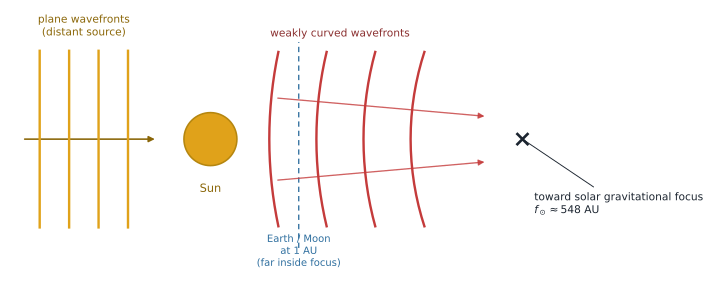
At 1 AU from the Sun we are very far inside this focal length, and the curvature imposed on the wavefront by the Sun's gravity is extremely weak. Concretely, the wavefront arriving at the Moon is not perfectly plane: it carries a small additional curvature corresponding to a virtual source displaced from infinity to a finite but enormous distance. The effective source distance, modified by the gravitational lens, is approximately
\[ r_{\text{eff}} \approx r\left(1 + r/f_\odot\right), \]
where the approximation holds because \(r/f_\odot\approx1/548\approx1.8\times10^{-3}\). The effective distance is altered by less than a fifth of a percent.
5.2 · Order-of-magnitude estimate
The fringe displacement produced by solar gravitational lensing of the wavefront incident on the lunar limb is
\[ \Delta x \approx x\cdot\frac{L}{2r}\cdot\frac{r}{f_\odot}. \]
For \(x\approx12.7\) m (the first bright fringe), \(L\approx3.84\times10^{8}\) m, \(r\approx1.5\times10^{11}\) m, and \(f_\odot\approx548\) AU:
\[ \Delta x \approx 3\times10^{-5}\ \text{m} = 30\ \mu\text{m}. \]
Less than the width of a human hair — real, computable, and far below anything measurable during an eclipse.
Writing the corrected Fresnel parameter as \(v'\) and its uncorrected form as \(v\), the fractional correction to \(v\) is about \(2.3\times10^{-6}\). A fringe nominally located at \(x=12.7\) m is displaced by roughly 30 micrometres as a consequence of solar gravitational lensing.
This displacement is not zero, and it is not an artifact: it reflects the genuine physical fact that the wavefront illuminating the lunar limb has been gravitationally focused. But it is wildly below any plausible measurement precision. Even if one could use the narrow chromospheric filament at second contact as an effectively point-like source, the positional stability of a ground-based apparatus to within 30 µm during the relevant milliseconds is not achievable under any realistic eclipse-observing conditions.
5.3 · A more promising regime
The irrelevance of the correction for visible-light eclipse observations does not mean the effect is unobservable in principle. It means only that the Sun–Moon–Earth geometry is not the right place to look. The effect becomes significant in regimes where the Schwarzschild radius of the lensing mass is comparable to the wavelength of the radiation — that is, where the diffraction and lensing length scales overlap.
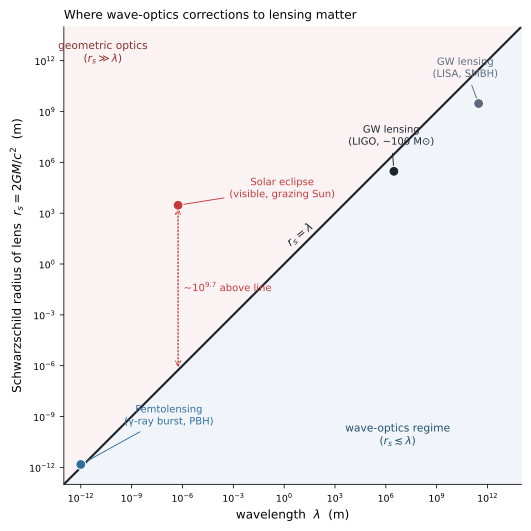
discrepancies.csv for the full derivation.)Two regimes where wave-optics lensing matters are (i) femtolensing of gamma-ray bursts by compact dark-matter candidates, where the Schwarzschild radius of a putative lens is comparable to the gamma-ray wavelength and wave-optics corrections genuinely modify the lensing signature, and (ii) the gravitational-wave lensing signals sought in LIGO and LISA data, where the long wavelength of the gravitational radiation brings the diffraction regime squarely into the observable window. In both cases the correct formalism is the Nakamura–Deguchi wave-optics treatment of lensing, not an aperture-diffraction formula with a redshift correction glued on.
Discussion
What has the exercise established? Three things, in ascending order of subtlety.
It has established, first, that the phrase “gravitational diffraction of light during a solar eclipse” refers to a real physical phenomenon, but not the one suggested by combining deflection and diffraction formulas. The real phenomenon is Fresnel knife-edge diffraction at the lunar limb, a purely wave-optical effect whose fringes would be observable at the ~15 metre scale on the ground if the source were genuinely coherent and point-like, and whose washed-out residue is responsible for the shadow bands occasionally reported at second and third contact.
It has established, second, that the natural-sounding temptation to write \(\theta=\lambda(1+2GM/rc^2)/D\) rests on a double misstep: the redshift factor is not a correction to locally measured wavelength, and \(\lambda/D\) is not the correct diffraction formula for an obstacle vastly larger than the wavelength. The instinct to combine gravity and diffraction is the right instinct; the specific combination, however, conflates two phenomena that operate on very different length scales and under very different formalisms.
It has established, third, that a real gravitational correction does exist — it arises from the curvature of the wavefront imprinted by the Sun's gravitational lensing action on light that later diffracts around the Moon — but that its magnitude for visible-light eclipse observations is of order \(10^{-6}\) in fractional fringe displacement and ~30 micrometres in absolute terms. The correction is real, computable, and far below observable. It becomes significant only in regimes, such as gravitational-wave or femtolensing, where the lensing focal length, wavelength, and geometric distances enter a different part of parameter space.
Conclusion
The eclipse is a richer optical laboratory than Eddington's 1919 measurement alone suggests. The same geometry that allows starlight grazing the Sun to be measured with arcsecond precision also arranges, for a few minutes of totality, a nearly textbook realisation of the Fresnel half-plane problem. The two effects coexist, but they operate on wildly different scales: gravitational deflection is an arcsecond-level phenomenon on angular coordinates, diffraction is a metre-scale phenomenon on transverse spatial coordinates, and the interaction between them — a refocusing of the wavefront by the Sun's gravitational lens before it encounters the Moon's limb — is a part-per-million perturbation on the diffraction pattern that is, for the moment, safely beyond reach.
Future work suggested by this analysis is modest and concrete. The Fresnel fringe prediction at second and third contact is, in principle, testable with sufficiently sensitive, high-speed, spatially-resolved photometry along the limb; the signal is dominated by source-size convolution, but the shadow-band literature already contains data that could be reanalyzed in this framework. The gravitational correction, by contrast, is not a useful target for terrestrial eclipse observation, but its scaling relations provide a bridge to the active literature on wave-optics gravitational lensing, where analogous geometry in a regime of comparable scales gives observable effects in gravitational-wave astronomy. The eclipse remains a laboratory. It is simply not the only laboratory, and for this particular question, it is not the best one.
References
- (1999). Principles of Optics (7th ed.). Cambridge University Press. Chapter 8 gives the standard treatment of Fresnel diffraction at a straight edge.
- (1919). “The total eclipse of 1919 May 29 and the influence of gravitation on light.” The Observatory, 42, 119–122.
- (1916). “Die Grundlage der allgemeinen Relativitätstheorie.” Annalen der Physik, 49, 769–822.
- (1963). “Investigation of the radio source 3C 273 by the method of lunar occultations.” Nature, 197, 1037–1039.
- (1973). Gravitation. W. H. Freeman.
- (1999). “Wave optics in gravitational lensing.” Progress of Theoretical Physics Supplement, 133, 137–153.
- (2003). “Wave effects in the gravitational lensing of gravitational waves from chirping binaries.” The Astrophysical Journal, 595, 1039–1051.
- (2019). “Diffraction of light by the gravitational field of the Sun and the solar corona.” Physical Review D, 99, 024044.